Genetic diversity is an important component of biological diversity. Rare and native breeds of farm animals and equines are part of our cultural heritage often associated with the type of traditional land management that is required to conserve important habitats. The breeds themselves have genetic traits that will be of value in the future, and it is crucial that we do not lose them.
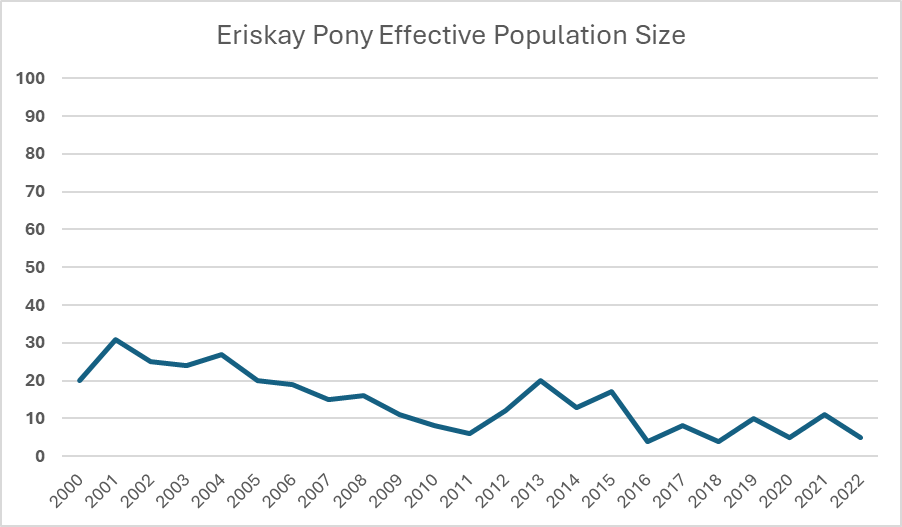
The genetic diversity of a breed is assessed by its effective population size which is based on the total number of animals in a population and the relative numbers of sires and dams. A low effective population size signifies a greater likelihood of inbreeding and subsequent loss of genetic diversity. For an equine breed to survive it is generally accepted that you need to have an effective population of 100 or more.
The Eriskay pony is the most critically endangered equine breed on the DEFRA lists with an effective population that has shrinking and now has reached critical level. The DEFRA figures show this decline over the years.
Perhaps a more positive way of looking at things is to consider the number of ponies in the potential breeding population. Our stud book records show that the total population is 408, of which 66 are over 30 years old. However, within these numbers are 33 ponies who have an unknown owner as the new keeper has not updated the passport as legally obliged to do.
Within this potential breeding population there are 95 mares who are 20 or under and 18 entire stallions.
In the last 5 years, just 20 Mares produced 29 foals using different 9 stallions. This is significantly less than was being produced in previous years and is an area of great concern. As part of the toolkit breeders use to inform breeding choices, Eriskay owners can access SPARKS which is a computer database that works with a genetic analysis programme called GENES to help breeders sustain and strengthen small populations. If used correctly, and appropriately, this will help maintain a healthy herd and slow down the loss of genetic material.
The Eriskay Pony Society has always encouraged owners to consider breeding and each year we forward the list of licenced stallions to mare owners and a list of mares to owners of licenced stallions. If every healthy youngster could produce 1 or 2 foals over a lifetime, this would go a long way to help in saving the breed and will restrict the loss of diversity.
Some stallions, owned by EPS or with the support of their owners, can be loaned allowing them to visit the mare and run with her at her home. In other cases, the mare can visit and run with him at the stallion’s home or at a breeding centre. For those mares living at livery, we may even be able to offer the possibility of a loaner taking the mare and foal through to weaning and deliver her back to her owner with or without plus one at foot.
Artificial Insemination and other types of assisted breeding are commonly used with many breeds and although it has been attempted with a small number of Eriskays, it has not yet resulted in a foal being born. The techniques for collecting and storing good viable semen is improving all the time and we very much hope that we will soon have a successful outcome. Would you like to be the first to succeed?
KEY POINTS.
- The future of the Eriskay Pony is in your hands.
- The situation is now critical.
- Can you breed from your mare?
- Help and support is available.
- Have you updated the Registrar with any changes to the information on your pony’s passport.
By Lorna Holden. Registrar (registrar@eriskaypony.org)


 THE ERISKAY PONY SOCIETY