Date for your diary

We will be holding our 26th ANNUAL GENERAL MEETING of the Eriskay Pony Society by video conference on Saturday 24 April 2021 at 11.00am.

Due to current Covid-19 precautions we’ll be holding the meeting remotely. It has been deemed an acceptable format by the Office of the Scottish Charities Registrar (OSCR) and Companies House for the conduct of the business of our organisation.

If you are a member and wish to join the meeting please contact our Secretary for details of how to join the teleconference.

If you don’t have access to an electronic device, you can use a land line telephone to join via audio only. Numbers will be limited to 50 participants so please book your place as soon as possible.

Election of Council Members

Written nominations, proposed and seconded by Members, and with an undertaking of willingness to serve, should be sent to the Secretary by post or e-mail at the address given above. Nominations must be received by the Secretary by 10th April 2021. All nominees must be members of the society.

Council Members

  • Yvonne Evans
  • Mary McGillivray
  • Catriona Cochrane
  • Ruth McMinn

are due to retire at this AGM but are willing to stand for re-election.

Featured talk

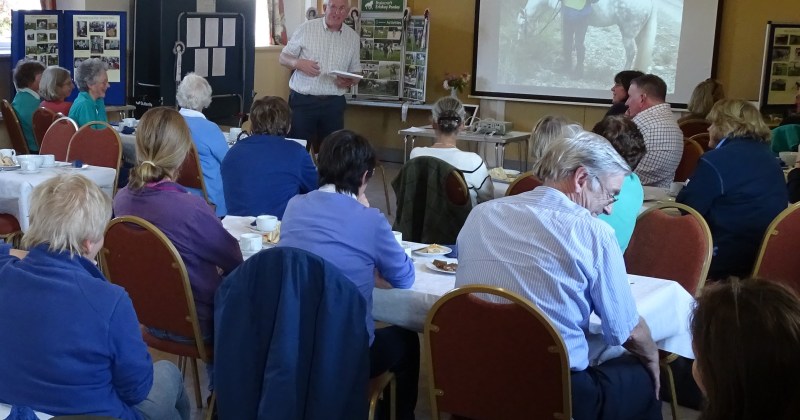
Our guest speaker, Sarah Evans of the Dales Pony Society will present a talk entitled ‘Promoting Native Pony Breeds’, followed by an open forum where members can ask questions or raise and discuss any issues that of general interest or concern.

We welcome this opportunity for all members, wherever you live, to take part in the running of the Society and we hope that as many of you as possible will join us for an enjoyable morning.

RBST MANIFESTO FOR SCOTLAND 2021

The Rare Breed Survival Trust has launched it’s Manifesto for Scotland detailing 6 areas where they feel Government could help and support native livestock and equines. They identify that native livestock and equines are a part of Scotland’s biodiversity, in just the same way as wild animals and that is why the UN Biodiversity Convention and the Sustainable Development Goals require Scottish Government, in common with all Governments, to take steps to conserve them.  

They say that the breeds were bred to provide particular benefits in particular locations and as a result are the ultimate ecosystem service providers. They also say that native ponies, like the Eriskay, are ideal for conservation grazing. Whilst Governments are expected to support our wildlife and built heritage they call on the Scottish Government to support its livestock heritage too.

They conclude that Rare and Native breeds have the potential to be an important part of the solution to the challenges facing agriculture. Lower inputs, less environmental impact, cultural significance, localised, high welfare production are all traits that are well established and recognised. These traits could have a positive impact on meeting our biodiversity goals, lowering our agri-environmental footprint and enhancing our agritourism offering. However, to date there has been no recognition within government that our native breeds have an important part to play and they ask that the new Scottish Government pro-actively recognise the value of our rare and native breeds and include them in policy development.

The full Manifesto can be read HERE

You can also visit their website; www.rbst.org.uk

Equine Herpes Virus 2021

There has been a serious outbreak of the EHV-1 strain of Equine Herpes Virus on the Continent, over 80 equines have tested positive, horses have had to be hospitalised and a number have died.

Equine Herpes Virus is spread mainly by nasal droplets which means it can be spread easily by animals between themselves, people that have been with infected animals (accidentally on their unwashed hands and clothing) or by sharing unsterilised horseboxes, stables, tack and feed equipment that has been used by infected animals.  It is important for the health and wellbeing of your equine that you follow guidance on biosecurity detailed below:

Your equine is at risk if in the last 30 days it has been imported to the UK from mainland Europe, had contact with equines that have been imported from mainland Europe or used a transporter that has transported equines from mainland Europe.

If your equine is at risk you should monitor for clinical signs (including twice daily temperature checks) before allowing the animal to come into contact with other horses and isolate the equine for a minimum of 28 days (assuming it remains free from symptoms).

If your equine starts to develop any of the following symptoms you should call your Vet and isolate the equine until two consecutive tests (serum samples and paired nasopharyngeal swabs) have been taken and tested a minimum of 10 days apart, to demonstrate that the equine is free from the disease – your vet will help you with these.

Symptoms of EHV-1

The signs of EHV-1 you should look for include;

  • raised temperature
  • lack of appetite (inappetence)
  • tiredness and/or lack of energy (lethargy)
  • runny nose (nasal discharge)
  • coughing
  • other signs may range from slight hind limb weakness through to paralysis (these are known as ‘neurological signs’)

Important note: You should contact your vet immediately if you suspect your equine may be infected with EHV-1.

Remember the virus can lie dormant and subsequently re-emerge when an equine is stressed at a later date (such as when transported or mixed with new equines).

Other helpful information and guidance can be found at:

HBLB Codes of Practice

British Equestrian